 Image 1 of 2
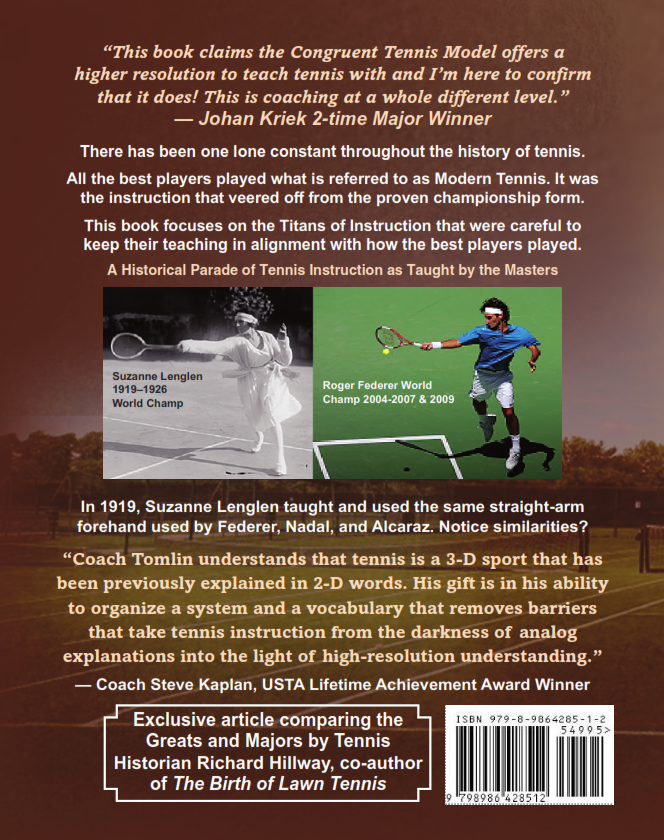 Image 2 of 2
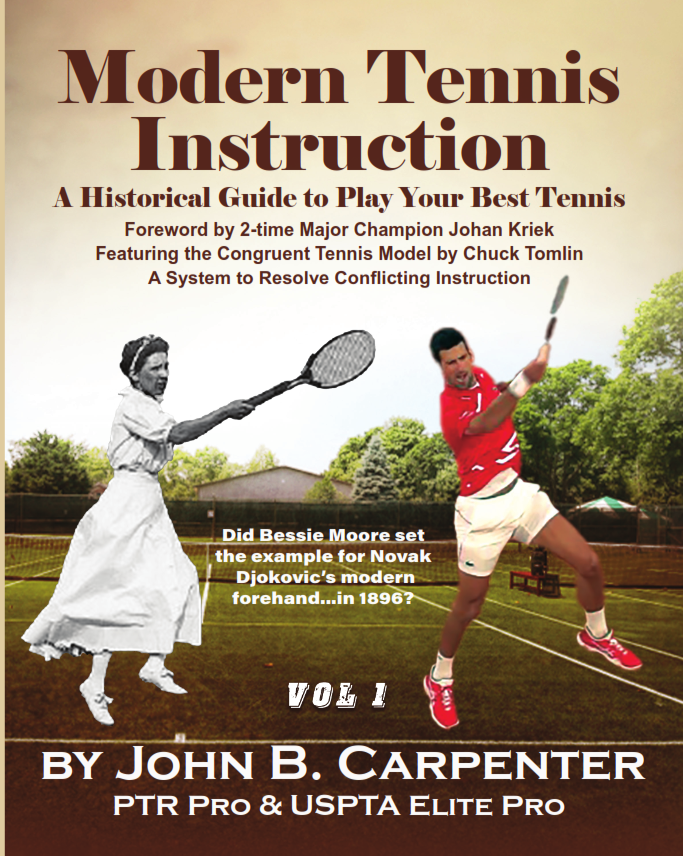
Richard Jones, tennis author, historian, and owner of the famous Tennis Gallery Wimbledon bookstore, wrote this review in England’s Tennis Historian magazine about Modern Tennis instruction: A Historical Guide to Play Your Best Tennis
“You could be mistaken for thinking this is a coaching book, but it’s not. Rather, it’s a comprehensive study of how the game has been taught over the first 150 years of its existence. The book is a riveting read for even the most non-technical person and is well worth the $75 cover price. Wayne Bryan’s 2012 letter to the USTA about coaching junior tennis is compelling and is reproduced in full (at Appendix A) and Richard Hillway’s 46 page thesis, ‘The Greatest Player Ever and the Grand Slam Tournaments’ is the fascinating product of extensive research.”
Statement by John Carpenter: Little did I know I would become known as our sport’s “tennis instruction historian.” In 2005 I went on a worldwide search for the best coaching method in the world. It took me 18 years to document 150 years of tennis instruction. I have been honored by the incredible reviews by great coaches and high-level players of this book but he real winner is a sport that now has a higher resolution to resolve conflicting claims about instruction. This is an ambitious book, calling for a new tennis vocabulary in order to simplify and streamline how tennis is best taught and played.
If you thought there was anything new taught in tennis from 1904 to 2007, you will be as shocked as I was. The 1887 World Champion from England hit like a right-handed Nadal with a full western grip. The straight arm versus bent arm debate started in the 1890s. Rotational power (what we call angular momentum) was taught and the “body swing” was understood well before 1900. An 1894 tennis manual by the first woman to graduate Harvard and Yale could be used today to teach Alcarez, Djokovic, Federer, or Sinner. By 1904, books with the title “Modern Tennis” in them taught the same drag the racket across the ball concepts we see in tennis today. Bill Tilden in the 1920s , but he was not original.
In 2007, Coach Chuck Tomlin published an article titled Smart Targets on the internet introducing the fade and draw paradigm to tennis. Some tried to dismiss this new concept, but it stood the fire of peer review from many of tennis greatest minds. In 2021, after extensive testing with pro coaches and players, I realized Tomlin’s The Congruent Tennis Model was the next evolution of coaching and playing. I asked him to introduce his ideas in two chapters in my book. His shot matching matrix in my judgement was the single great innovation in the 21st century to date.
Chuck Tomlin and I work as consultants for coaches around the world. But our first love is showing how easy it is to emulate pros in form and style, even if at slower speeds. So you will find us both on the court, working with juniors and players who know they can get better through a higher resolution of understanding. We don’t teach players as much as we free them up. This will make sense when you meet with us on court. We also do video consulting. Give me a call at 805-200-6106 (Austin, TX) or Chuck Tomlin can be reached at 404-643-6067 (Atlanta, GA).
Richard Jones, tennis author, historian, and owner of the famous Tennis Gallery Wimbledon bookstore, wrote this review in England’s Tennis Historian magazine about Modern Tennis instruction: A Historical Guide to Play Your Best Tennis
“You could be mistaken for thinking this is a coaching book, but it’s not. Rather, it’s a comprehensive study of how the game has been taught over the first 150 years of its existence. The book is a riveting read for even the most non-technical person and is well worth the $75 cover price. Wayne Bryan’s 2012 letter to the USTA about coaching junior tennis is compelling and is reproduced in full (at Appendix A) and Richard Hillway’s 46 page thesis, ‘The Greatest Player Ever and the Grand Slam Tournaments’ is the fascinating product of extensive research.”
Statement by John Carpenter: Little did I know I would become known as our sport’s “tennis instruction historian.” In 2005 I went on a worldwide search for the best coaching method in the world. It took me 18 years to document 150 years of tennis instruction. I have been honored by the incredible reviews by great coaches and high-level players of this book but he real winner is a sport that now has a higher resolution to resolve conflicting claims about instruction. This is an ambitious book, calling for a new tennis vocabulary in order to simplify and streamline how tennis is best taught and played.
If you thought there was anything new taught in tennis from 1904 to 2007, you will be as shocked as I was. The 1887 World Champion from England hit like a right-handed Nadal with a full western grip. The straight arm versus bent arm debate started in the 1890s. Rotational power (what we call angular momentum) was taught and the “body swing” was understood well before 1900. An 1894 tennis manual by the first woman to graduate Harvard and Yale could be used today to teach Alcarez, Djokovic, Federer, or Sinner. By 1904, books with the title “Modern Tennis” in them taught the same drag the racket across the ball concepts we see in tennis today. Bill Tilden in the 1920s , but he was not original.
In 2007, Coach Chuck Tomlin published an article titled Smart Targets on the internet introducing the fade and draw paradigm to tennis. Some tried to dismiss this new concept, but it stood the fire of peer review from many of tennis greatest minds. In 2021, after extensive testing with pro coaches and players, I realized Tomlin’s The Congruent Tennis Model was the next evolution of coaching and playing. I asked him to introduce his ideas in two chapters in my book. His shot matching matrix in my judgement was the single great innovation in the 21st century to date.
Chuck Tomlin and I work as consultants for coaches around the world. But our first love is showing how easy it is to emulate pros in form and style, even if at slower speeds. So you will find us both on the court, working with juniors and players who know they can get better through a higher resolution of understanding. We don’t teach players as much as we free them up. This will make sense when you meet with us on court. We also do video consulting. Give me a call at 805-200-6106 (Austin, TX) or Chuck Tomlin can be reached at 404-643-6067 (Atlanta, GA).